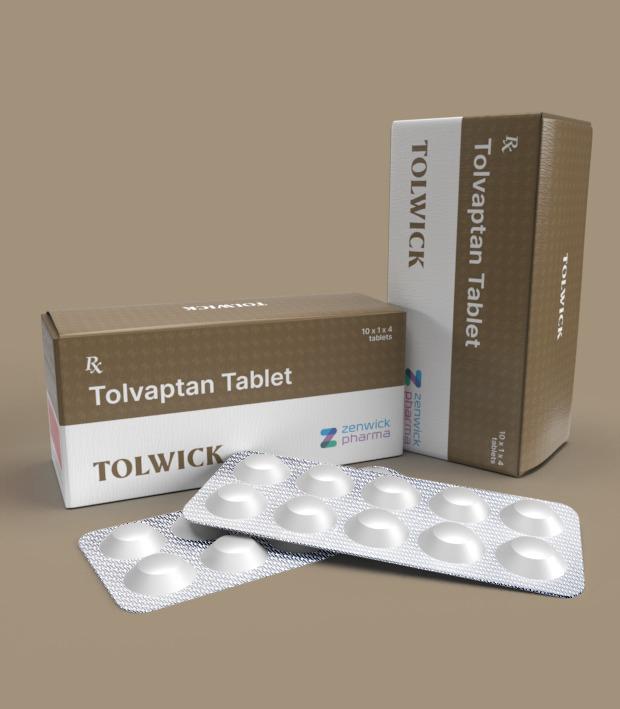
COMPOSITION
Each tablet contains:
Tolvaptan ... 15 mg/30 mg/60 mg (as per specific product strength)
Excipients ... q.s.
CLINICAL PHARMACOLOGY
Tolvaptan is a selective vasopressin V2-receptor antagonist. It promotes aquaresis by blocking the
binding of arginine vasopressin (AVP) to the V2-receptor in the distal nephron, thereby reducing
water reabsorption without significant loss of electrolytes.
INDICATIONS AND USAGE
1. Treatment of clinically significant hypervolemic and euvolemic hyponatremia (serum sodium <125
mEq/L) including patients with heart failure and SIADH.
2. Slowing kidney function decline in adults at risk of rapidly progressing autosomal dominant
polycystic kidney disease (ADPKD).
CONTRAINDICATIONS
1. Patients with anuria.
2. Patients who are unable to respond to thirst.
3. Hypovolemic hyponatremia.
4. Concomitant use with strong CYP3A inhibitors.
5. Patients with autosomal dominant polycystic kidney disease outside FDA-approved use.
PRECAUTIONS
Monitor serum sodium and volume status closely.
Avoid fluid restriction during initiation.
Use caution in patients with hepatic impairment.
Discontinue if hepatic injury is suspected.
DRUG INTERACTIONS
1. Strong CYP3A inhibitors (e.g., ketoconazole, clarithromycin) increase tolvaptan exposure.
2. CYP3A inducers (e.g., rifampin) may reduce efficacy.
3. P-gp inhibitors may increase plasma levels of tolvaptan.
PREGNANCY & LACTATION
Pregnancy: Use only if clearly needed. Animal studies showed fetal toxicity.
Lactation: Unknown if tolvaptan is excreted in human milk. Discontinue drug or breastfeeding based
on benefit-risk assessment.
DOSAGE AND ADMINISTRATION
Hyponatremia: Initial dose: 15 mg once daily. May increase to 30 mg or 60 mg based on response.
ADPKD: Initial dose: 45 mg on awakening and 15 mg 8 hours later. Titrate to maximum of 90 mg/30
mg.
Administer orally with or without food.
ADVERSE REACTIONS
Common: Thirst, dry mouth, polyuria, nausea.
Serious: Hepatic injury, dehydration, hypernatremia, hypotension.